New practice advice for planners inclusive of visualisations, released by the Royal Town Planning Institute (RTPI) and authored by Dr Paul Cureton (Lancaster University) and Dr Anna Jackman (University of Reading), offers a glimpse of how aerial drones and the infrastructure underpinning them could be positively integrated into the places where people live, work and play, provided their integration is carefully planned.
Alongside their use as tools for planners, drones are already being trialled and deployed across the UK for applications including infrastructure inspection and medical and goods delivery. Policymakers and publics alike are, however, largely yet to grasp the possible impact this technology could have on the built environment.
UK Government ambition statements aspire that commercial drones become commonplace by 2030. While the two new RTPI practice advice notes, Planning and drones 1: Using drones to deliver planning services and Planning and drones 2: Planning for scaled drone use and infrastructure, highlight the potential benefits of drone technology as it emerges and scales, they also caution of the importance of forward-thinking planning from the outset.
Without careful attention and engagement from planners, the advice warns, communities could encounter noise and visual disturbance, privacy and security issues, and disruption to wildlife and habitats.
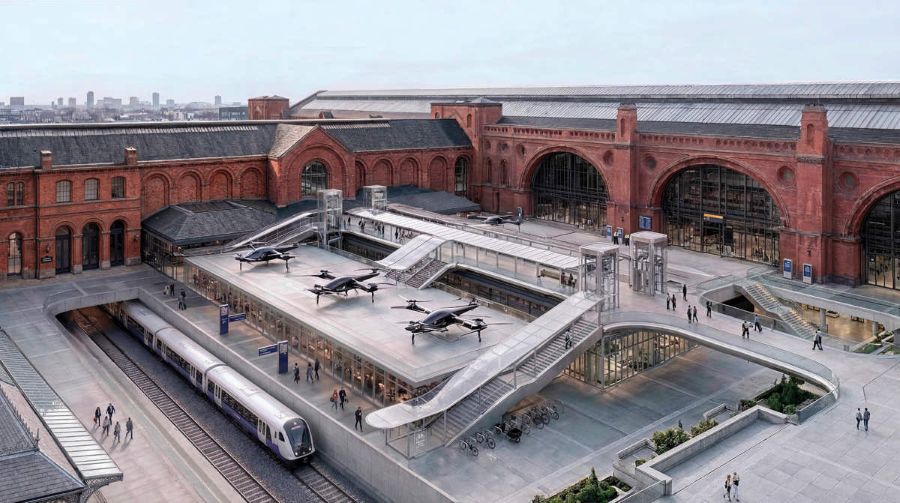
Image: ON-A
Where the technology is appropriate, communities must be involved in meaningful consultation enabling a genuine say in technological deployment and how the technology shapes their neighbourhoods. Planners and the public should have the ability to say ‘no’ to drone developments where they are genuinely not in the public interest.
The current lack of robust planning frameworks could also undermine investment in drone infrastructure that would be of public benefit. Indeed, the drone company Manna recently pulled out of plans for developing delivery hubs in Ireland, citing a lack of ‘appropriate national policy framework’. This followed events such as the company reportedly being refused permission to retain a delivery drone hub in Dublin, following the issuing of a planning enforcement notice.
The new practice advice encourages planners to begin proactively considering these issues, as well as the potential public impacts of drones, now – rather than in response to further technological developments.
The accompanying visualisation, created for the RTPI by the architectural studio ON-A, depict potential drone futures and are valuable illustrative tools, showing how thinking about drones and their infrastructures early may allow it to be carefully and considerately integrated in the everyday spaces and lives of communities.
Together, the guidance and visualisations urge planners, policymakers and communities alike to consider not simply whether drones will become more common, but what a successful, societally and socially beneficial drone future could look like.
Dr Daniel Slade MRTPI, Head of Research and Practice at the RTPI, said: “It often feels like technological changes, and the impacts they have on our lives, are inevitable. But that is not the case. As a society, we must be better at influencing how things like drones shape our neighbourhoods, villages, towns and cities for the public good, and not only commercial benefit. Planners and the planning system are at the vanguard of this. Local plans in England are supposed to look 15 years ahead. The time for communities and planners to imagine a better future and plan for it is now.
Dr Paul Cureton and Dr Anna Jackman said: “Drones increasingly animate skies in the UK and beyond. While employed by both planners and external civil and commercial operators for a range of beneficial applications, so too are drones – and the ground-based infrastructure enabling them – variously contested.
“From masts to launch and landing pads, the scaling of drone operations introduces issues such as noise disturbance and wildlife disruption, requiring careful consideration. While recognising guidance, resource and capacity challenges, planners nonetheless remain vital stakeholders to consider if, how and where drones are appropriate, societally and economically beneficial investments for their communities.”
Saúl Ajuria, Architect and Partner, ON-A, said: "Throughout history, cities have evolved by incorporating new layers of infrastructure—from railways and highways to energy and digital networks. Drone infrastructure should be approached with the same long-term perspective. The challenge is not simply to accommodate new technologies, but to ensure they contribute positively to the character, identity and everyday experience of our built environment."
"As architects and designers, we believe technology should be understood as part of a wider spatial, environmental and social system. The success of this new paradigm will depend on our ability to integrate these emerging infrastructures into our cities in ways that respect public space, heritage, biodiversity and the communities that inhabit them, while creating places that remain resilient, liveable and distinctly human."
The RTPI says further national policy and guidance will be needed as drone technology and regulation develop. However, planning authorities can begin considering now how drone infrastructure and operations may affect their areas.