Construction output increased by 0.3% between 1Q2026 and 2Q2026, according to the latest data from ONS.
Compared with the same quarter in 2025, output in 2Q2026 was down by 2.0%.
New work increased by 0.4% on the quarter but fared less well on the year, falling by 6.1%. Meanwhile, R&M output increased by 0.2% between 1Q2026 and 2Q2026, and by 3.9% on the year.
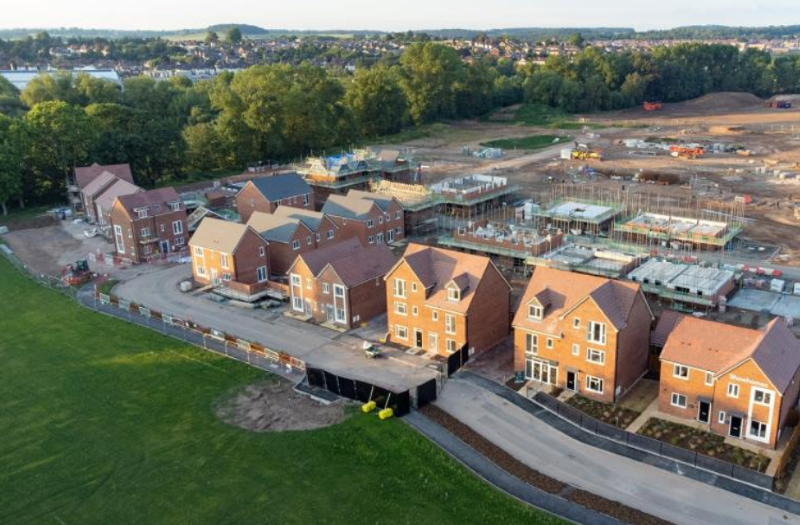
In new work, the greatest quarterly movements were a 4.1% fall in public new housing output and a 3.4% decrease in public non-housing new work, which includes health and education projects.
On the year, all new work sectors, with the exception of private commercial, experienced a decline in output. The steepest fall was a 14.8% decline in public housing output. Conversely, annual growth was recorded across both public housing and private housing R&M, with increases of 3.7% and 5.4% respectively.
Construction’s 0.3% growth contributed to 0.4% growth in GDP overall in 2Q2026. Output in the services sector increased by 0.5% while production output showed no growth (2).
Dr David Crosthwaite, chief economist at BCIS, said: “What’s evident from the latest ONS data release is the marked contraction in new construction work this year. Since 4Q2025, new work has fallen in each quarter compared with the same period a year earlier. The trend is also clear in the monthly data, with new work output contracting year-on-year for nine consecutive months as of June.
“This continues to reflect several conditions. First, the economy remains stagnant, as a result of well-reported pressures, including the uncertainty arising from the conflict in the Middle East and its impact on client and investor confidence. Reduced new work ultimately means reduced investment in fixed capital.
“Another notable takeaway is what’s driving that contraction. Monthly new housing output remains a weak point in the construction market across both the public and private sectors, with output contracting year-on-year for the past six and eight months respectively. Sustained contraction is also evident in infrastructure.
“We should certainly recognise the resilience of the industry given supply chain disruption, renewed inflationary pressures and soft demand seen in the first half of 2026. Looking ahead, it’s essential the new government administration sets a stronger course. New construction is particularly important for economic growth because its impact extends well beyond individual sectors, supporting activity across a wide network of suppliers and businesses.
“The Autumn Budget must therefore be a vehicle for incentivising investment and restoring business confidence. The data are clear: for many areas of construction, the main challenge is increasingly the lack of certainty over future demand.”
On a monthly basis, data for June 2026 show construction output decreased by 0.1% on May and by 2.3% on the volume in June 2025. New work was down by 0.3% and 5.9% on the month and year, while R&M output recorded no monthly growth and an annual increase of 2.8%.
In new work, the most significant monthly changes in output were recorded in public housing, down by 11.0%, and public non-housing, down by 2.8%. Meanwhile, public and private housing R&M output both increased on the month, by 1.8% and 1.3% respectively.
Total construction new orders fell by 11.9% in 2Q2026 compared with 1Q2026, with £9.2 billion of work committed, according to the latest ONS data. On an annual basis, new orders were down by 18.1% and were also 16.4% below their level in pre-pandemic 2019.
No sector recorded an increase in new orders between the first and second quarters. The steepest fall was seen in new orders excluding housing and infrastructure, where orders contracted by 22.0%.
Compared with 2Q2025, private industrial new orders experienced the strongest growth, rising by 33.1%. In contrast, new orders excluding housing and infrastructure saw the sharpest decline, falling by 45.8%, followed by a 28.5% decrease in private commercial new orders.
Dr David Crosthwaite, chief economist at BCIS, said: ”The latest new orders data reinforce the weakness we’re seeing across the construction market, with new orders down on the quarter and the year in the second quarter.
“There are some positives in the data, including a 12.9% annual increase in new orders for private housing, but these are outweighed by substantial declines elsewhere, including in public housing, infrastructure and private commercial work. It’s increasingly clear that the reduced investment appetite for new construction is not isolated or a short-term issue.
“This raises a significant question for the new government: how will it rise to the challenge and help recover that appetite? The construction industry entered 2026 expecting some degree of recovery, but so far that has not materialised. The question now is whether government allows these conditions to persist or takes action to strengthen confidence and improve the appetite for investment.
“If we continue to see a sustained downturn in activity and future demand, there is a real risk that the consequences become more pronounced. Prolonged weakness could put further pressure on already stretched supply chains, contribute to a spike in insolvencies and ultimately cause longer-term damage to capacity across the construction industry.
“That would be directly counterproductive for wider economic growth, which apparently remains a central government priority. Growth ultimately gives the government greater capacity to make decisions that improve living standards and strengthen the UK’s economic resilience. Construction has an integral role in that future, and the government cannot afford to overlook it.”