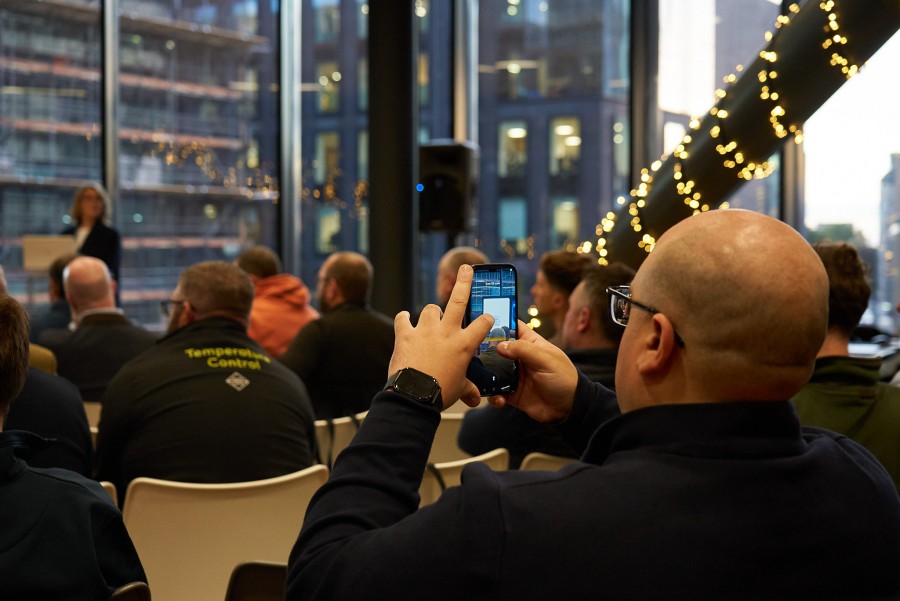
Samsung Climate Solutions has officially launched its DVM S2 R32 in the UK, bringing together architects, building services specialists and industry commentators in Manchester and London to examine the changing demands on commercial cooling.
Samsung Climate Solutions has marked the UK launch of its DVM S2 R32 commercial VRF system with two industry events at HOME Manchester and Samsung KX in London, bringing together professionals from across the built environment to discuss the challenges shaping the future of commercial cooling.
Alongside the introduction of Samsung's latest R32 technology, the events featured presentations and panel discussions examining the growing importance of climate resilience, evolving refrigerant regulations and the practical implications for those designing, specifying, installing and maintaining commercial cooling systems.
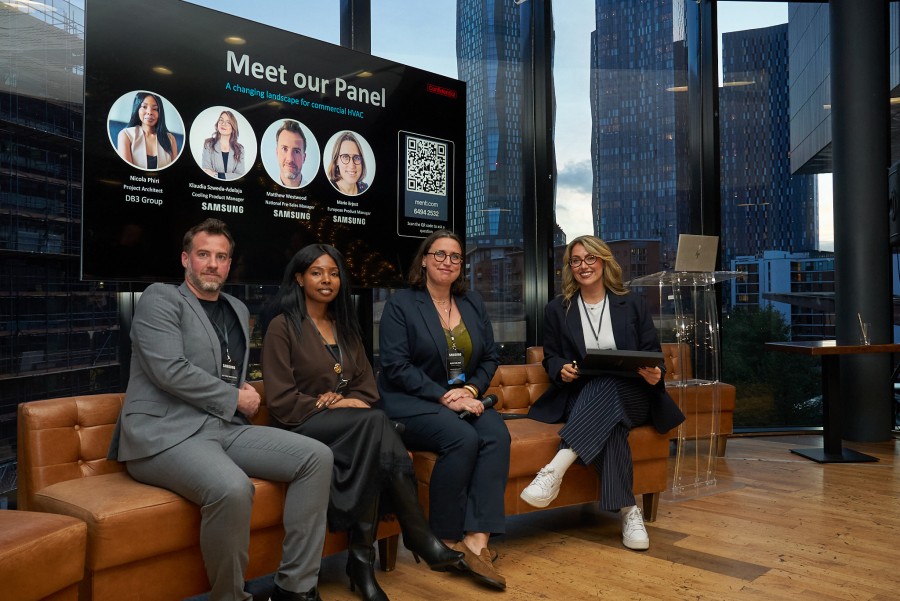
Contributors included Kevin Morrissey, Technical Director at the Building Engineering Services Association (BESA), Nicola Phiri, Project Architect at DB3 Group, and industry editor, Andrew Gaved, alongside Samsung’s UK and European experts, bringing perspectives from across architectural design, building services engineering and the wider HVAC industry.
Increased pressures across commercial cooling
The role of cooling in commercial buildings across the UK is changing. Expectations around comfort and building performance continue to evolve, while warmer summers and more extreme temperatures are bringing climate resilience to the forefront of the conversation.
At the same time, regulatory changes are accelerating the transition towards lower Global Warming Potential (GWP) refrigerants. R32 has a GWP of 675, compared with 2088 for R410A¹, making it an important refrigerant choice for commercial VRF applications.
However, reducing the environmental impact of refrigerants is only part of the challenge. Systems must also meet the practical demands of commercial buildings, from safety and installation constraints to acoustics, controls and long-term operation.
The discussions in Manchester and London highlighted the importance of considering these requirements together, particularly as the industry balances environmental targets with the need to deliver safe, comfortable and efficient buildings.
Nicola Phiri, DB3 Architects, said: “With growing pressure to improve building performance, energy efficiency and occupant comfort, cooling needs to be considered much earlier in the design process. Collaboration between architects, engineers and manufacturers is essential, particularly when retrofitting existing buildings, where spatial constraints, costs and long-term performance all need to be carefully balanced.”
Navigating the refrigerant transition
The transition towards lower-GWP refrigerants is also introducing new considerations for the wider HVAC industry, particularly around safety, installation practices and the skills required to work with evolving technologies.
As the market continues to evolve, ensuring that contractors and engineers have access to appropriate training, technical guidance and manufacturer support in order to deliver the transition effectively.
Kevin Morrissey, Technical Director at BESA, said: “The industry has already made significant progress in reducing the environmental impact of refrigerants, but as demand for cooling continues to grow, so too does the pressure on the workforce.
“The transition to lower-GWP refrigerants makes workforce competence more important than ever. We need to ensure the industry has the capacity to attract, train and retain skilled engineers, while supporting existing professionals to develop their knowledge and experience in response to changing regulations and technologies.
“As extreme heat becomes more frequent, active cooling will increasingly be seen as a necessity rather than a luxury. The challenge is to ensure that passive and active measures work together, while continuing to deliver safe, efficient systems that meet growing expectations around building performance, occupant comfort and energy costs.”
Klaudia Szweda-Adelaja, Product Manager at Samsung Climate Solutions, added: “Commercial cooling is facing several changes at once, from the transition to lower-GWP refrigerants and evolving regulation to increasing expectations around comfort and climate resilience. We need to look beyond refrigerant choice and consider how systems will perform throughout their lifetime, while ensuring the industry has the knowledge and skills to work with new technologies.”
Responding changing needs
The launch of Samsung's DVM S2 R32 forms part of its response to these changing requirements. Designed to operate with R32 refrigerant, the system has been developed specifically for commercial applications including offices, hotels and mixed-use buildings.
Through product presentations and demonstrations at both events, attendees were introduced to the system's features and the practical considerations associated with specifying and installing R32 technology.
The DVM S2 R32 incorporates key safety measures, in accordance with IEC 60335-2-40², directly into the system design. Its integrated shut-off valve boxes and MCU configurations further contribute to simplified installation and enhanced system stability.
Matthew Westwood, National Senior Pre-Sales Manager at Samsung Climate Solutions, said: “The challenge is to reduce environmental impact without compromising safety, comfort or performance. Our discussions in Manchester and London highlighted the importance of collaboration across the industry, and how manufacturers, consultants and contractors can work together to deliver commercial cooling solutions that meet the changing needs of buildings and their occupants.”
Samsung's DVM Pro software provides system design and refrigerant calculations, enabling consultants and installers to design compliant systems with confidence.
The DVM S2 R32 is SmartThings ready, with an integrated Wi-Fi kit enabling users to monitor and control system operation remotely through the SmartThings App³. It is also SmartThings Pro ready, supporting integration with advanced building management platforms.
For more information, visit: DVM S2 R32 Outdoor
¹ GWP R32: 675, GWP R410A: 2088
² DVM S2 R32 includes two of the safety measures required by IEC 60335-2-40. No additional requirements needed for the installer.
³ A Samsung SmartThings application account and internet connection are required. Requires iOS 10.0 or later & Android 5.0 or later.