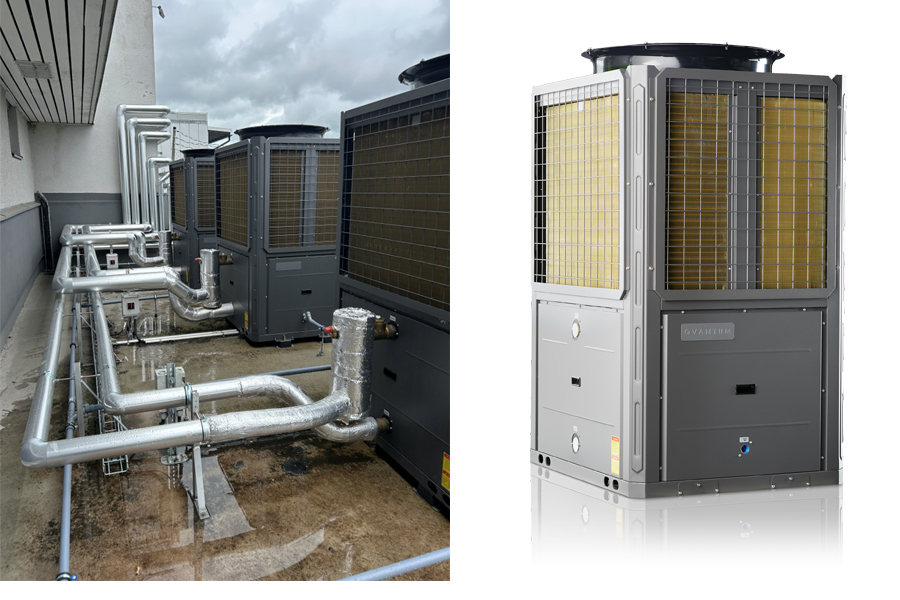
The Heat Sharing City explores how buildings could work together to harness wasted heat and create more flexible, efficient urban energy systems.
Qvantum, the Swedish energy technology company and heat pump manufacturer, has launched a new report, The Heat Sharing City, exploring how connected heat pumps, ambient heat networks and smarter controls could help cities recover wasted heat, ease energy demands and build more adaptable heating infrastructure.

Replacing gas boilers with heat pumps is a critical part of the UK's transition to low-carbon heating, particularly as new building standards accelerate the move away from fossil fuels. But, according to the new report, in densely populated urban areas, replacing one technology with another is only part of the answer, and the next stage of that transition will require buildings to work together, rather than solve their heating and cooling needs in isolation.
Heating and cooling buildings in densely populated urban areas brings a distinct set of challenges. Space for equipment is limited, noise needs to be considered, heating and cooling demands overlap, and electricity networks face growing pressure. Meanwhile, developers, building owners and operators must make decisions about infrastructure that will shape the performance and value of buildings for decades.
Yet the report argues that urban density also creates an opportunity. Offices, supermarkets, data centres and transport infrastructure generate heat that is often discarded, potentially close to buildings that are paying to produce heat of their own. The Heat Sharing City brings together perspectives from across the housing, engineering and heat sectors to examine how these energy flows could be connected and used, and the practical considerations involved in making shared heat infrastructure work.

Key themes and recommendations include:
1. The challenge: Individual boiler replacement is only the first step
Swapping a gas boiler for a heat pump cuts emissions in one home. It doesn't recover heat from the building next door, balance heating and cooling, or reduce peak demand. Connected heat pumps are the first stage of the transition to smart heat networks.
2. The enabling layer: Connectivity makes shared heat possible
Without visibility and control, heat pumps remain individual pieces of equipment. With them, they become part of a managed system that can detect faults early, shift demand away from peak periods, and adapt over time. Connectivity should be considered from day one, not bolted on later.
3. The opportunity: Shared heat, in new build and retrofit
Ambient loops let buildings that need heat draw from them, while buildings that need cooling reject heat back into them. The report explores how this works across new schemes, existing estates and older heat networks, and why systems should be judged on how they perform in year fifteen, not just on day one.
4. Delivery: From opportunity to implementation
A heat-sharing network is a piece of urban infrastructure, not a larger heating system. The report sets out a six-step route from mapping the place to detailed designand examines the commercial and organisational models shared infrastructure needs, from who leads to who owns, operates and answers for long-term performance.

“We’ve spent much of the transition to low-carbon heating focused on replacing one technology with another, but in our cities we need to think bigger,” comments Philip Ord, UK CEO of Qvantum. “Buildings shouldn’t be operating in isolation when there is so much potential to share energy between them. By connecting heat pumps and designing systems around how buildings interact, we can make better use of heat that would otherwise go to waste and build more flexible, resilient energy infrastructure. The challenge now is to turn that potential into practical projects.”
The report can now be downloaded here.