The retirement
housebuilding sector looks set for a sustained slowdown as major players take a
cautious approach to land after the government’s decision to ban leases on
flats.
The ban was
announced late last year after a media campaign on the growth – and
exploitative sale – of leaseholds on new houses. Instead of just banning leases
on houses, the government opted to ban leases on all new build properties.
As most new-build
retirement properties are leasehold flats, this is having a significant impact
on workloads that looks set to continue.

In the year to
August 2018, completions fell 7% to 2,134 units at the UK’s biggest retirement
homebuilder, McCarthy & Stone. At Churchill Retirement, the second largest
player, completions slipped 1% to 521 units in the year to June 2018.
After the ban was
introduced, the major retirement homebuilders have been talking to government
about an exemption.
In the last
financial year, McStone’s land programme shrank with 54 land exchanges – down
from 75 in 2017 – while Churchill acquired 13 sites including 540 plots
compared to 24 sites including 875 plots in 2017.
Churchill’s chairman
and chief executive officer Spencer McCarthy said: “The investment model for
our specialist form of development depends on capitalised ground rent income to
fund the provision of extensive non-saleable communal space that is essential
to our product.
“Until we have more
clarity from government on this issue, or legislation is passed, our leases
will continue to include fair ground rents, linked to RPI on standard review
terms.”
McStone achieved 37
planning consents – down from 64 in 2017 – but Glenigan’s construction market
analysis shows both leading retirement homebuilders applying to build more
homes through the planning system.
In the 2017 calendar
year, there were 1,908 units included in detailed planning applications made by
McStone according to Glenigan’s data. That total is a rise of 41% on the 1,350
units in the group’s planning pipeline in 2016.
Since 2015,
Churchill’s planning pipeline has nearly tripled. Glenigan’s market analysis
shows 938 units included in detailed planning applications made by the group
last year.
However, Glenigan’s
research shows that the overall planning pipeline for retirement homes has
shrunk.
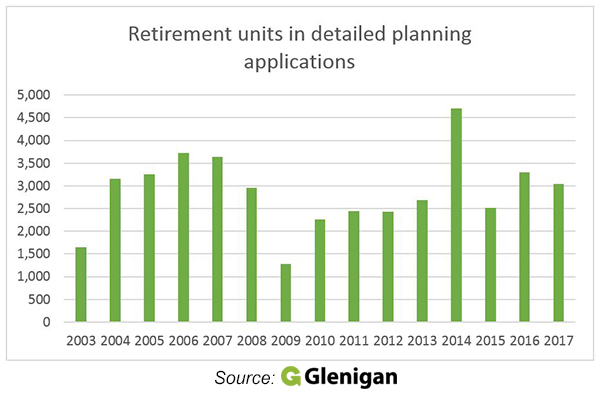
Coming out of the
recession, the annual pipeline of units in detailed planning applications grew
relatively steadily from 2009 and had increased by 268% by 2014, only to fall
away.
The number of
retirement units in planning applications in 2015 was down 46% on the previous
year.
In 2016, there was a
rebound and a 31% rise in the planning pipeline of retirement homes but last
year brought another fall with a drop of 8% amidst fears over the introduction
of the ban.
With the planning
pipeline still growing at McStone and Churchill, this suggests that other
smaller retirement homebuilders may be being deterred by the new rules on
leases, which does not augur well for future workload in the sector.