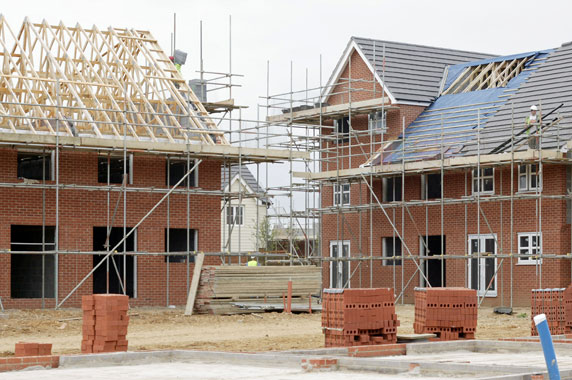
Reducing housing targets set for each local authority to an advisory status risks the country failing to achieve the national ambition to build 300,000 new homes each year, CIC has warned.
In its response to government’s National Planning Policy Framework (NPPF) consultation, CIC says that allowing each local planning authority to decide their planning targets could result in fewer houses being built.
The need for mandatory and standardised whole-life carbon assessments as part of planning applications, and more sites for SMEs in local plans, are other key CIC responses.
The NPPF sets out the Government’s planning policies for England and how these should be applied. The latest consultation was published by the Department of Levelling Up Housing and Communities in December 2022.
CIC has suggested there should be quota of site allocations for SME housebuilders in each local plan to ensure that they continue to play a role in the housing market. It proposes that Homes England allocate parcels within their strategic developments to local SME housebuilders. And it has expressed concern at the proposed removal of the obligation to review green belts in order to meet housing targets.
The government’s proposal for a 35 per cent uplift on housing targets for the core cities is another measure that CIC opposes.
Professor Tony Crook CBE, Emeritus Professor of Town & Regional Planning at the University of Sheffield and chair of CIC’s Housing Panel, said: “In our view this uplift seems to be unrelated to housing need and does not take sufficient account of capacity or the need for infrastructure investment to make brownfield sites genuinely available for development. We also have concerns related to densification and over development which in the past have often taken place in the more deprived communities of the core cities.”
CIC has been firm in its endorsement of using the planning system to accelerate decarbonisation of the built environment and is urging government to make whole-life carbon assessments for buildings mandatory as well as provide more guidelines and adopt a standard methodology.
Stephen Hodder MBE Chair of CIC’s Climate Change Committee said: “Clear guidance and an effective regulatory framework for whole-life carbon that ensured it was be accounted for early within a project would be hugely beneficial in terms of costs and effectiveness of reducing carbon emissions.”
CIC has played an active role in promoting sustainable drainage systems (SuDS) and supports the strengthening of national policy on biodiversity and managing surface water.
The response also points to the need for more consideration of microclimate design in the form of ‘climate-based masterplanning’ for new developments as part of climate change adaptation and mitigation. “Planners need to understand the role of built form and green infrastructure as well as considering orientation and air flow,” it says.
Together with our more than 700 members from across the sector, UKGBC has now responded to the consultation with recommendations for the Government to reform the planning system to more effectively tackle the climate crisis, halt nature’s decline, and develop greater climate resilience.
Philip Box, Policy Adviser at UKGBC said: “Many of the Government’s proposals set a welcome direction for planning reform, particularly the consideration of carbon accounting and measurement for planning purposes and attention given to small-scale nature enhancement and climate adaptation.
“However, a great deal of specific detail appears pushed back to future consultations, at a time when our path to net zero and nature recovery simply cannot afford further delay.
“The Government should urgently take forward the key policies we recommend, backed by amendments to the Levelling Up and Regeneration Bill and aligned to the environmental targets set out in UK law, to ensure the planning system is fit for purpose.
“Our response draws on our members’ collective experience and expertise at the forefront of the built environment and sets out key recommendations for a more strategic and comprehensive approach. We look forward to further consultation with the Government on how the planning system can play its part in delivering a net zero, climate resilience, regenerative UK.”