This content is a sponsored publication provided by Compass Pools, an award-winning company with over 30 years’ experience in the design, construction and installation of luxury pools.
The UK’s Build-to-Rent (BTR) market has been steadily maturing over the past few years, and the amenities arms race has shifted from superficial social spaces to high-yield, service-led wellness infrastructure.
Contemporary demographics are increasingly prioritising preventative health and daily wellbeing routines over passive amenities. For architects and specifiers, this translates into a challenge of integrating luxury features that can be structurally demanding for constrained floor plans and limited loading capacities.
One of the most popular features that blends luxury with functionality is the pool, but it’s also an amenity that requires significant structural reinforcement, dedicated plant rooms, and ongoing specialist maintenance which can erode profit margins and consume valuable letting area. To overcome these structural and financial constraints, Compass Pools advocates a shift toward compact swim spa technology, aligning luxury expectations with high-yield BTR commercial models.
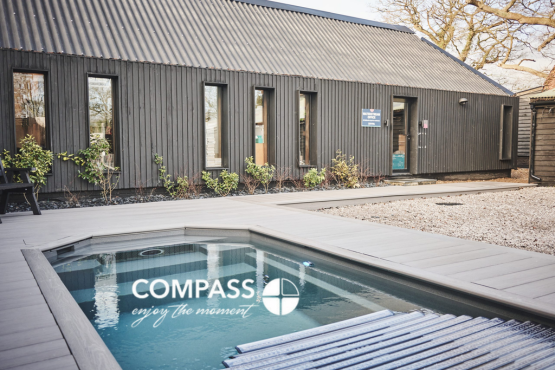
Solving the weight dilemma
Conventional masonry pool constructions are fundamentally incompatible with BTR economics. A standard 12-metre concrete lap pool imposes a dead load that approaches 30-40 tonnes when filled. This means substantial slab thickening is needed together with additional columns that compromise spatial efficiency across multiple floors. The alternative of pre-engineered, compact swim spas and endless pools reverses this problem entirely.
Carbon fibre ceramic core pools aren’t just lightweight but deliver incredible tensile strength and are far more insulating, allowing for longer heat retention. It eliminates the worry of stress points cracking under pressure, without adding to the weight, and this weight reduction has direct economic consequences. Reduced structural loading allows for shallower floor zones, which either increases lettable height within planning envelopes or permits additional floor levels within constrained urban sites.
Just as significant is the spatial efficiency offered by compact endless pool systems, which deliver meaningful resistance for greater swimming capability within footprints as small as 15 square metres, less than half the area required for even modest conventional lap pools. In a development, where every square metre represents potential for more rental income, this space utilisation fundamentally alters the business case for aquatic amenities.
Operational efficiency: Automating the amenity
The operational burden of traditional pools has historically deterred some BTR operators from pursuing such amenities. Multi-skilled pool technicians, chemical dosing regimens, and manual cleaning schedules represent ongoing costs that can undermine yield performance.
Self-cleaning floor systems and automated filtration reduce manual intervention to little more than a periodic filter cartridge replacement, while precision chemical dosing linked to real-time pH monitoring maintains water quality without the need for specialist oversight.
The structural advantage of one-piece ceramic cores becomes particularly acute in multi-storey applications. Traditional tiled pools have grout joints and flexible sealants that deteriorate under thermal cycling and structural movement, leading to water migration into the building fabric—a catastrophic failure mode in residential developments.
Seamless ceramic surfaces eliminate these vulnerability points, while permitting direct integration with Building Management Systems to allow for remote monitoring of water chemistry, temperature, filtration cycles, and energy consumption. This connectivity takes aquatic facilities from isolated maintenance liabilities and turns them into centrally managed building assets.
Spatial mastery in restricted footprints
What makes compact swim spas viable is the flow resistance technology. High-velocity jets generate a smooth, adjustable current which allows users to swim in place, replicating the biomechanical demands of lap swimming without the spatial requirements for stroke turnover.
A well-engineered swim spa can deliver training resistance equivalent to a traditional pool, while compressing the functional utility into a fraction of the footprint. This allows for aquatic facilities to occupy otherwise underutilised spaces, whether they’re recessed into rooftop terraces, integrated into double-height floors, or positioned as flush-level features within communal landscaping.
Reducing the acoustics is another key detail, since pool equipment generates mechanical vibration and airborne noise that can transmit into residential floor plates if it isn’t decoupled properly. Make sure that specifications include resilient mounting systems with neoprene or spring isolators rated for the equipment's operating frequency, alongside structural breaks between pool vessels and load-bearing slabs, to tackle this issue.
Swim spa technology recalibrates what’s technically and economically feasible in BTR plans. Lightweight carbon-ceramic construction eliminates the structural penalties that have historically confined pools to ground-level locations, while automated operational systems align ongoing costs with the leaner budgets BTR operators demand. For specifiers trying to balance resident expectations with operational practicality, these systems offer a pathway to genuine wellness infrastructure that protects long-term asset value.