Cities are growing at an incredible rate. Currently, 55% of the world’s population lives in urban areas and the United Nations projects that 68% of the global population will be living in cities by 2050.
With this influx of people, designers and planning authorities are continually challenged with creating successful urban environments, creating places where people want to live and work, increasing housing supply and providing infrastructure.
As the pace of change accelerates, Connected Places Catapult and KPF are looking at what the future holds for masterplanning; how emerging data-driven technologies will positively disrupt traditional practice to help us deliver faster, more agile, future-proofed masterplans to meet the needs of the 21-century city.
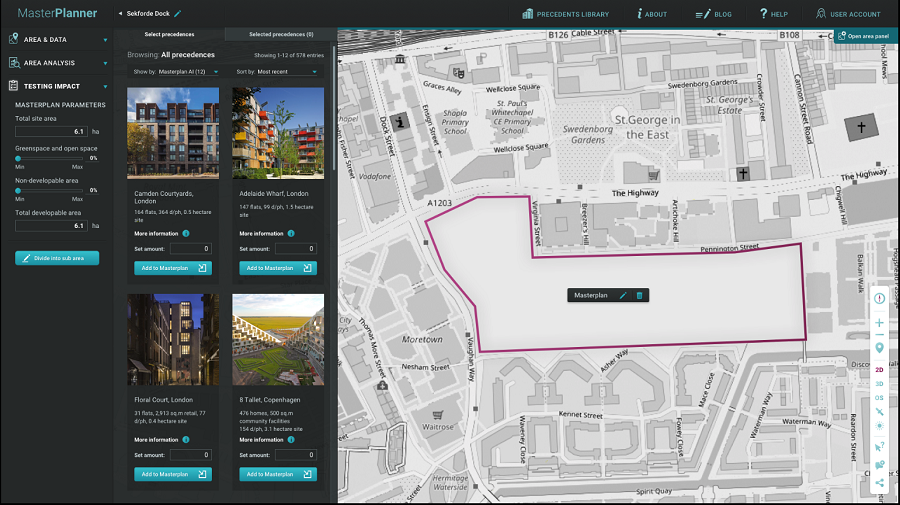
The result of their collaboration is the design of a hypothetical digital tool with three major innovations:
- Aggregate data needed to understand site context by drawing from public and private sector organisations by plugging into their existing application programming interfaces (APIs). In the UK, this could provide mapping data from Ordnance Survey; planning policy from the local planning authorities; traffic counts from historic surveys; cultural and historical assets, as designated by local people; or existing movement patterns from mobile phone data. This would replace time-consuming, piecemeal research required to gather and map out contextual data.
- Using third-party algorithms to undertake analysis and test impact. These algorithms would be provided by specialist consultants, for analysis of topics such as transport, daylight and wind testing. Others might be open source, provided by public authorities analysing open space deficiency or housing need.
- A live data-rich precedent library, much like the library of building components you get in many BIM and 3D software tools, but with up-to-date data from existing built developments across the world. This would include data on occupancy, energy use and sales values, as well as floor plans and construction costs.
These innovations would radically change the amount of time spent gathering and analysing data, allowing designers to quickly iterate and test design options. Data from the precedent library could be combined with real-time data from the surrounding context, automatically calculating the impact of selected building options on traffic, open space and social infrastructure. This could be used to compare against policy in real-time, highlighting key issues.
The result wouldn’t be a finished masterplan, but a robust understanding of the impact that different development scenarios would have, allowing architects, developers and local authorities to be better informed about the changing relationship between their proposals and the local neighbourhood.
Cobus Bothma, Director of Applied Research, Kohn Pedersen Fox Associates, said: “We see this as a tool to augment the traditional skills of the architect. This would radically change the way that architects and master planners practice, allowing them to spend less time gathering all the relevant information for site analysis and freeing up more time for creative work. We’re already using some of these techniques to help clients optimise their sites.”
Euan Mills, Head of Digital Planning, Connected Places Catapult, said: “Some of this might feel farfetched. It relies on innovations in how data is provided from the public sector and new business models from the private sector. Disruption is inevitable which will make masterplanning more robust and responsive.”
To learn more about the collaboration between Connected Places Catapult and KPF, both parties are hosting a digital masterplanning talk as part of the London Festival of Architecture. To register to attend, click here: https://cp.catapult.org.uk/events/digital-masterplanning-london-festival-of-architecture/